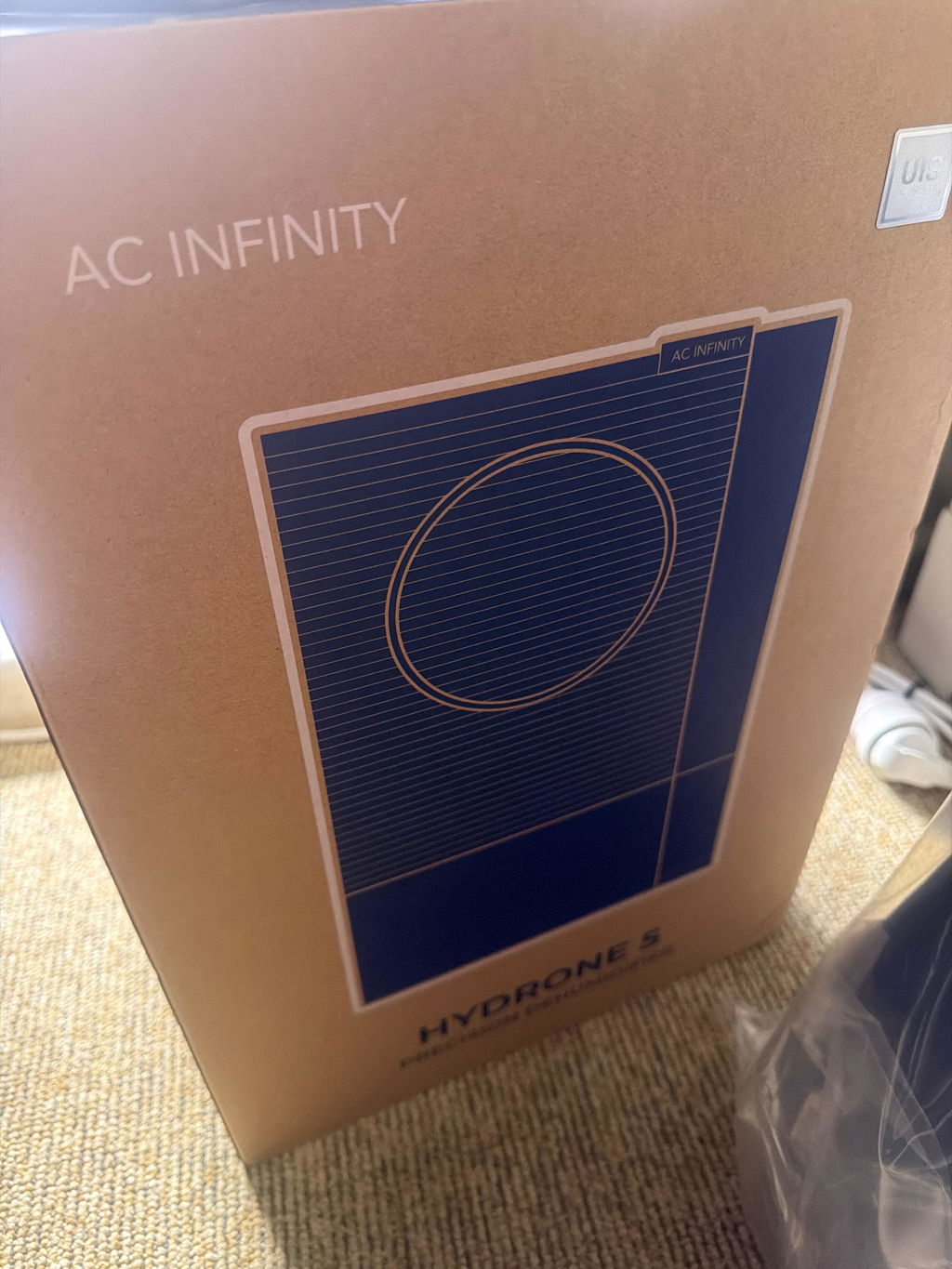
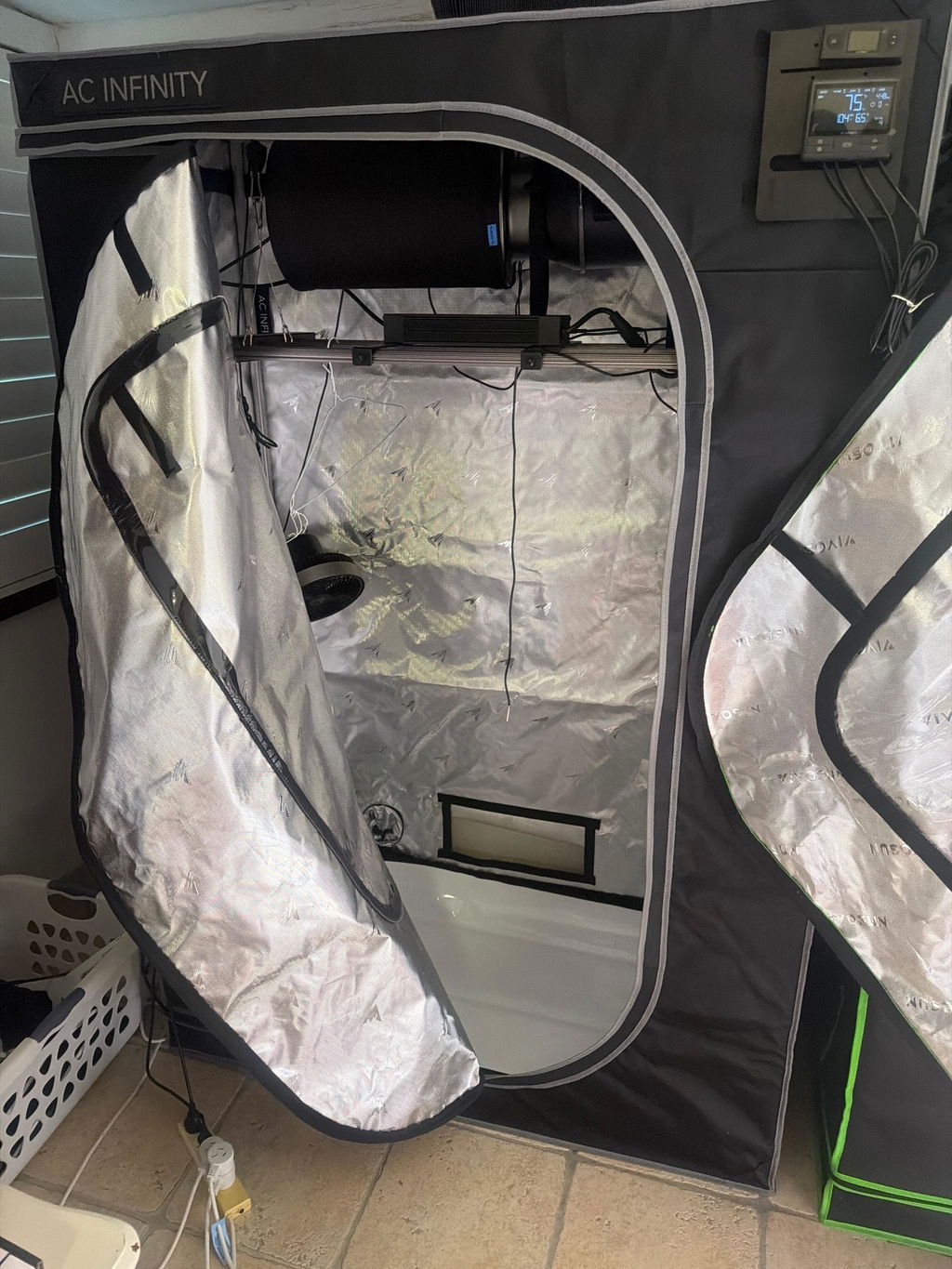
The AC Infinity Hydrone 5 is a dehumidifier designed for a grow tent rather than adapted from a household appliance, and the difference shows in what it can do. A PWM-controlled rotary motor gives ten drying levels with instant on/off response instead of a compressor that can only lurch between full power and nothing. It pulls a tent down to as low as 25% RH, it keeps working in cold conditions where compressor units give up, and dual 150 mm ports let you duct it properly — including a closed loop that isolates the tent from the air around it. Quick Bloom Lights is the official Australian importer: stocked in Sydney, Australian plug fitted, warranty handled here.
Precision a compressor can't match
A compressor dehumidifier is a blunt instrument. It runs flat out until it hits your setpoint, switches off, drifts, and switches on again — so humidity saws up and down around the number rather than sitting on it, and the compressor wears through start cycles doing it.
The Hydrone 5's PWM rotary motor is modulated rather than switched. Ten distinct drying levels with instant on/off response mean it can be dialled to match the rate your space actually gains moisture, then left to hold there. In a sealed tent, where the moisture load is steady and predictable, that is exactly the behaviour you want: a small continuous pull that holds a target, rather than a large intermittent one that overshoots it.
It works in the cold, which is where most units stop
This is the Hydrone 5's real advantage and it gets overlooked. Compressor dehumidifiers depend on chilling a coil below the dew point, so as a room gets colder they lose efficiency fast and many simply stop being useful, or spend their time defrosting instead of drying. Winter and lights-off periods are precisely when tent humidity climbs.
AC Infinity engineered the Hydrone 5 for consistent performance in hot and cold grow environments, with a rated operating range of 7–35°C. If your space is in a garage, a shed or anywhere unheated through winter, that is a far more useful property than a large litres-per-day figure measured in a warm test chamber.
Sizing it right
The Hydrone 5 is at its best in tents up to 0.9 × 0.9 m (3×3). In that space it holds humidity steady through the whole cycle, day and night. AC Infinity rate it for tents up to 1.2 × 1.2 m (4×4), and it will hold a 4×4 in drier conditions — but a 3×3 is where it really shines.
The thing that decides how well it keeps up is the air coming in. The Hydrone 5 is excellent at keeping the air in a tent dry. What it can't do is dry a constant stream of humid fresh air as fast as a fan pushes it in. Run closed-loop, keep fresh-air intake to what the tent actually needs, and give it the driest lung room you can — then it stays ahead. For a 4×4 in a humid space, or through a humid Sydney summer, talk to us first and we'll help you size the setup so humidity stays where you want it.
Get the best out of it
How you set the Hydrone 5 up makes a substantial difference to the result, so it is worth getting these right:
- Run it closed-loop. Both ducts connected to the tent isolates it from the surrounding air and is the most efficient configuration — it is what we recommend for most setups.
- Match your exhaust fan speed to it. An extraction fan running flat out pulls fresh air through the tent faster than any dehumidifier can dry it. Put both on one controller, or set a sensible fan level.
- The drier your lung room, the better the result — especially when you are chasing low tent humidity in summer.
- Expect some warm exhaust air. That is normal for the technology, not a fault. In a space already fighting heat, duct the output out of the tent.
Not sure whether it suits your space? Send us a message before you buy and we will tell you straight.
What people use it for
Where it earns its place
- Sealed tents where the outside air is humid too
- Rooms running CO2, where venting isn't an option
- Unheated garages and sheds through winter
- Holding a humidity target overnight after lights-off
- Closed-loop setups isolating the tent from the room
Typical setups
- Grow tents up to 0.9 × 0.9 m (3×3)
- Late flower, when humidity control matters most
- Drying spaces needing a steady, adjustable pull
- VPD-driven automation alongside a UIS controller
- Anywhere ducting the dry air matters
Full specifications
| Manufacturer | AC Infinity Inc. |
| Product / model | HYDRONE 5 / AC-DHT5 |
| UPC | 819137025202 |
| Coverage | Best in grow tents up to 0.9 × 0.9 m (3×3); AC Infinity rating up to 1.2 × 1.2 m (4×4) |
| Engine | PWM-controlled rotary motor |
| Drying levels | 10, with instant on/off response |
| Real-world draw rate | 4 L/day (not directly comparable to compressor ratings) |
| Lowest achievable humidity | 25% RH |
| Reservoir | 2 L, with optional gravity drain hose |
| Duct ports | Dual 150 mm (6″) — exhaust plus optional intake |
| Dimensions | 242 × 260 × 398 mm |
| Power | 209–350 W |
| Voltage / frequency | 240 V AC / 50 Hz |
| Power connection | Australian three-pin plug |
| Operating range | 7–35°C / 30–90% RH |
| Onboard control | Dry Mode across 10 levels; auto-memory restore after a power cut |
| With a UIS controller | Humidity and VPD triggers, app access, data charts and alerts |
| Safety alerts | Tank status, tilt detection, overheat protection |
| Programming guide | View online |
FAQ
Will it keep up in a 4×4 tent?
In drier conditions, yes — AC Infinity rate it to 4×4. Where it gets stretched is a 4×4 pulling in humid fresh air, because it can't dry incoming wet air as fast as a fan pushes it in. It is at its best up to 3×3. If you're running a 4×4 in a humid space, send us your setup and we'll help you get it right.
Why 4 L/day when a hardware-store unit claims 20?
Because the two figures are not measured the same way, and they are not solving the same problem. A compressor unit's rating comes from a warm, very humid test chamber it will rarely see in your space, and it describes bulk extraction from a large open volume. AC Infinity publish the Hydrone 5's 4 L/day as a real-world draw rate and state plainly that it is not directly comparable. In a sealed tent the job is not to shift twenty litres — it is to remove moisture at the rate the space produces it, continuously and at a level you can dial in. That is what this unit is built to do.
Will it work in a cold space?
Yes, and this is one of the main reasons to choose it. It is rated 7–35°C and engineered for cold environments, where compressor dehumidifiers lose efficiency sharply or spend their time defrosting. If your tent is in an unheated garage or shed, that matters more over a winter than any headline capacity figure.
How should I duct it?
Closed-loop is the setup we recommend: both the exhaust and the optional intake port connected to the tent, so the unit dries the tent's own air rather than continuously processing whatever is in the room. Alternatively, run the exhaust into the tent and leave the intake open to draw from the lung room. Either way the ports are 150 mm, the same as a 6″ inline fan, so standard ducting fits.
Does it blow out warm air?
Some, yes, and that is normal rather than a fault — removing moisture from air releases heat. Worth planning for in a space that is already running warm: duct the exhaust out of the tent rather than back into it, and remember your extraction fan is still doing the temperature work.
Where does the water go?
Into a 2 L internal reservoir that you empty, or continuously through a gravity drain hose if you have somewhere below the unit to run it. On a tent producing steady moisture the drain hose is worth setting up so the unit never stops on a full tank.
Do I need a controller?
Not to use it. On its own the Hydrone 5 runs Dry Mode across ten levels and restores your setting automatically after a power cut. What a UIS controller adds is triggering — humidity and VPD targets, rather than a fixed level — plus app access, charts and alerts. If you already run an AC Infinity fan on a controller, adding the dehumidifier to it is the single biggest improvement you can make, because the two stop working against each other.
Will it dry out a whole room?
It is built for a sealed tent, and it performs best up to about 0.9 × 0.9 m (3×3). In a large open room, or a damp house or subfloor, moisture comes in faster than a tent-sized unit removes it — that is a ventilation problem and home ventilation is the better answer. Tell us your space and we will say honestly whether this is the right unit.
Is this genuine AC Infinity stock with Australian warranty?
Yes. Quick Bloom Lights is the official Australian importer and distributor for AC Infinity. Stock is held in Sydney, orders ship domestically, the unit comes with an Australian three-pin plug, and the two-year warranty is handled here rather than through an overseas seller.