

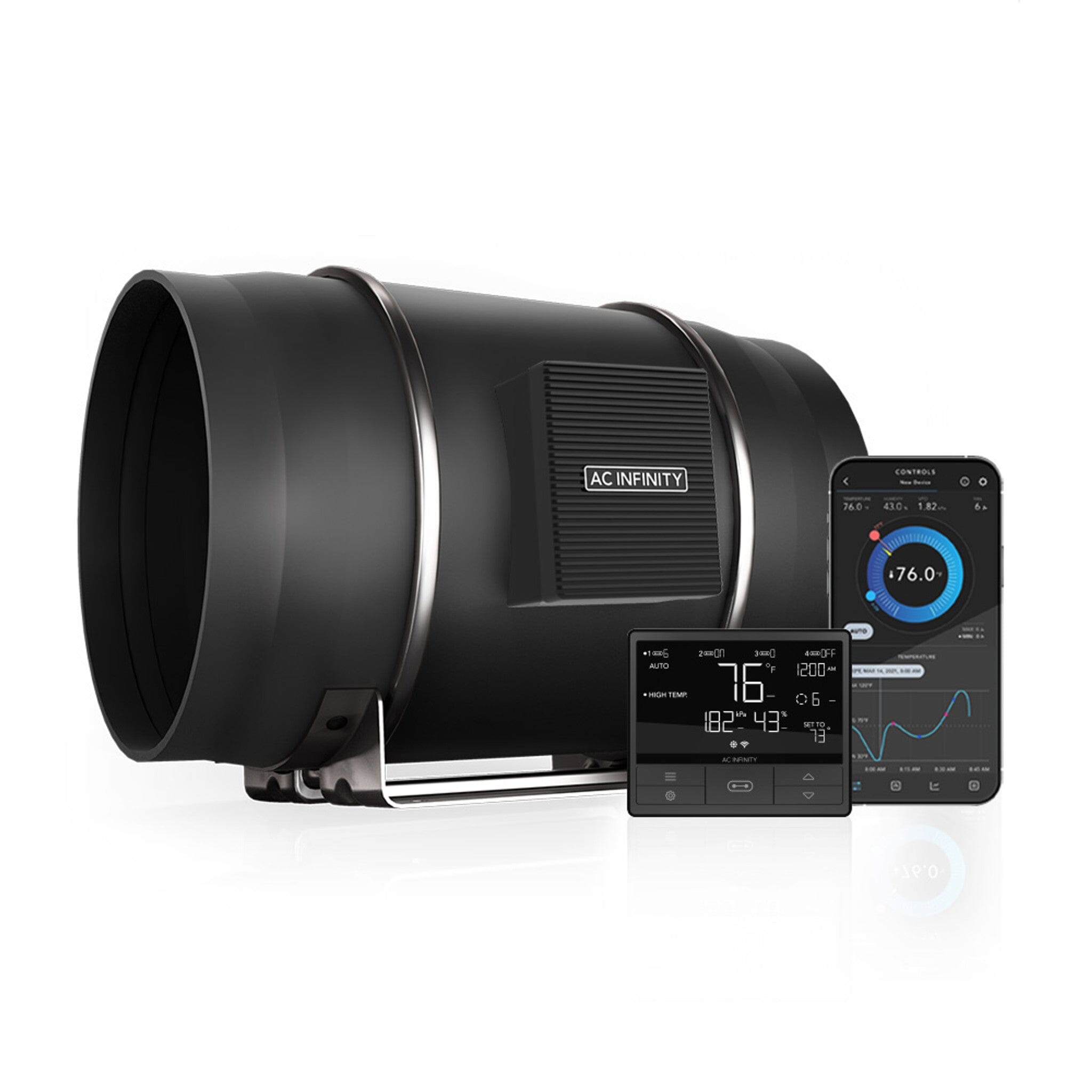
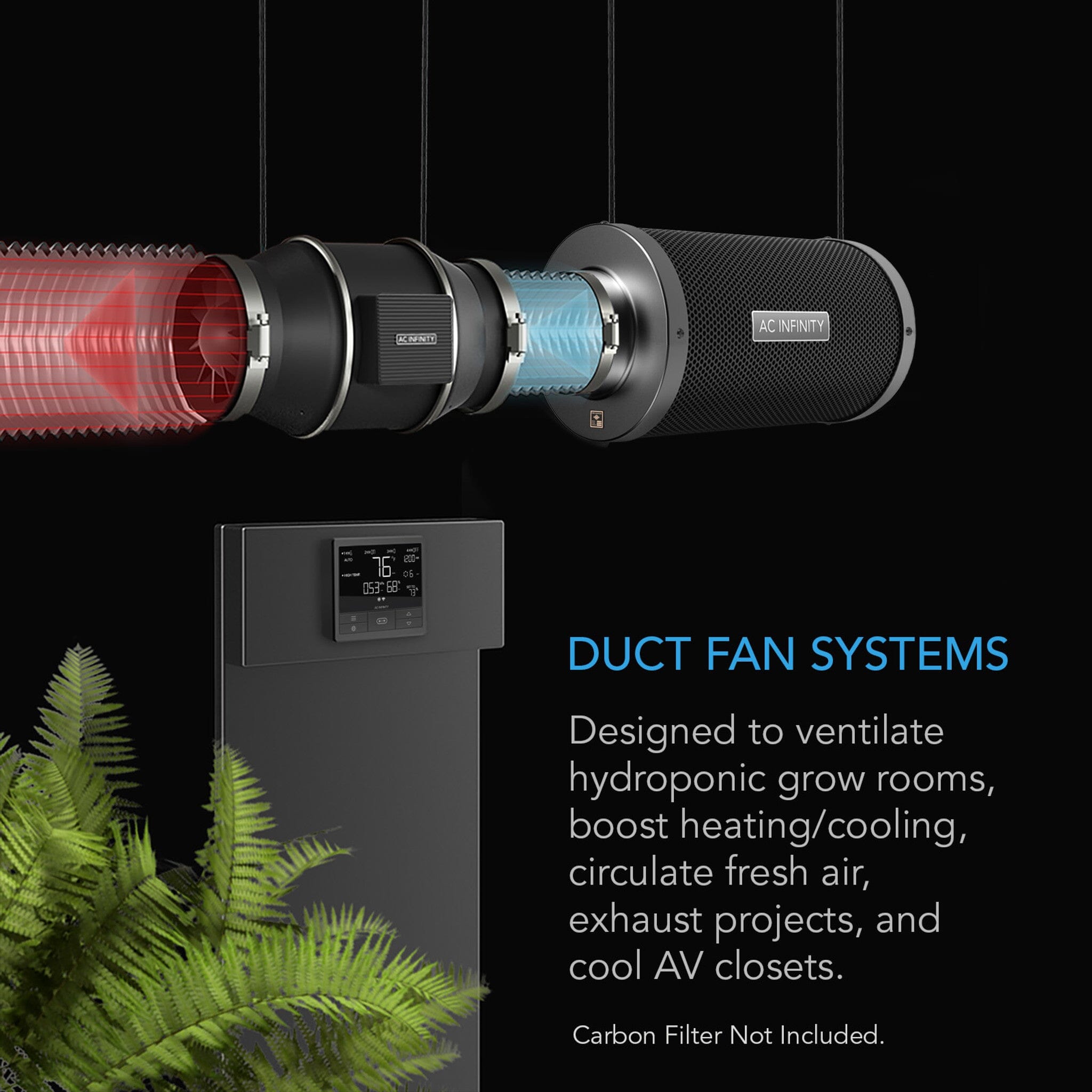


The AC Infinity CLOUDLINE PRO T12 is a 300 mm (12″) smart inline duct fan and the largest in the CLOUDLINE range — 2,725 m³/h · 757 L/s (1,604 CFM) from a mixed-flow impeller and PWM-controlled EC motor, with the Controller 69 Pro for temperature, humidity and VPD triggers, dynamic speed, timers, schedules and WiFi app control. This is a high-volume fan for rooms, warehouses and commercial ducted systems. It is not a quiet tent fan, and the section below on noise says so plainly.
Smart climate control
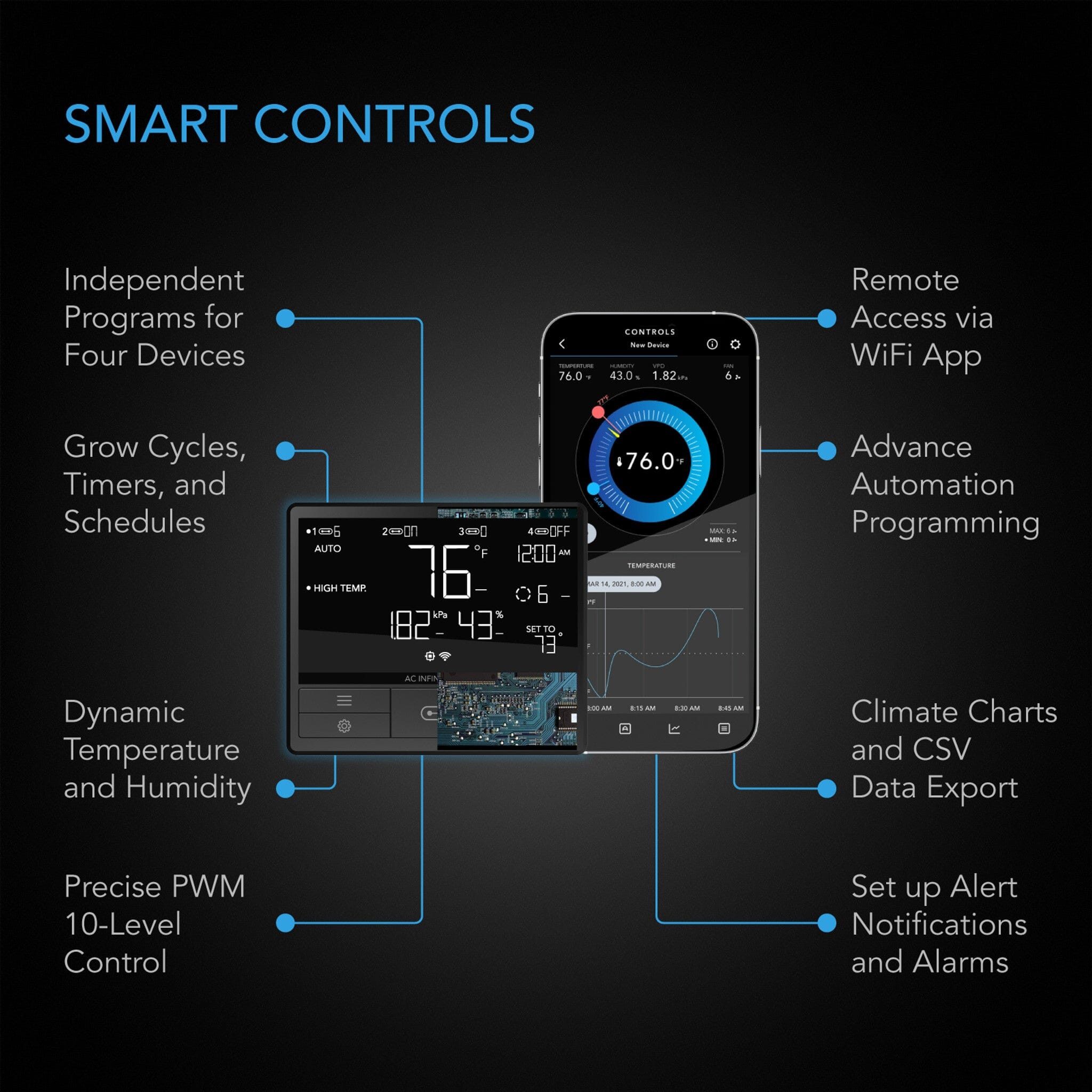
The Controller 69 Pro does more than switch the fan on and off. Set temperature, humidity and VPD triggers and the fan responds proportionally — speed rises as conditions drift and eases back as they recover, instead of slamming between off and full. Set a minimum speed and it never fully stops, so you keep constant air exchange through a carbon filter rather than letting odour build between cycles. Timer, cycle and schedule modes cover lights-on/lights-off routines, staged extraction and scheduled purges.
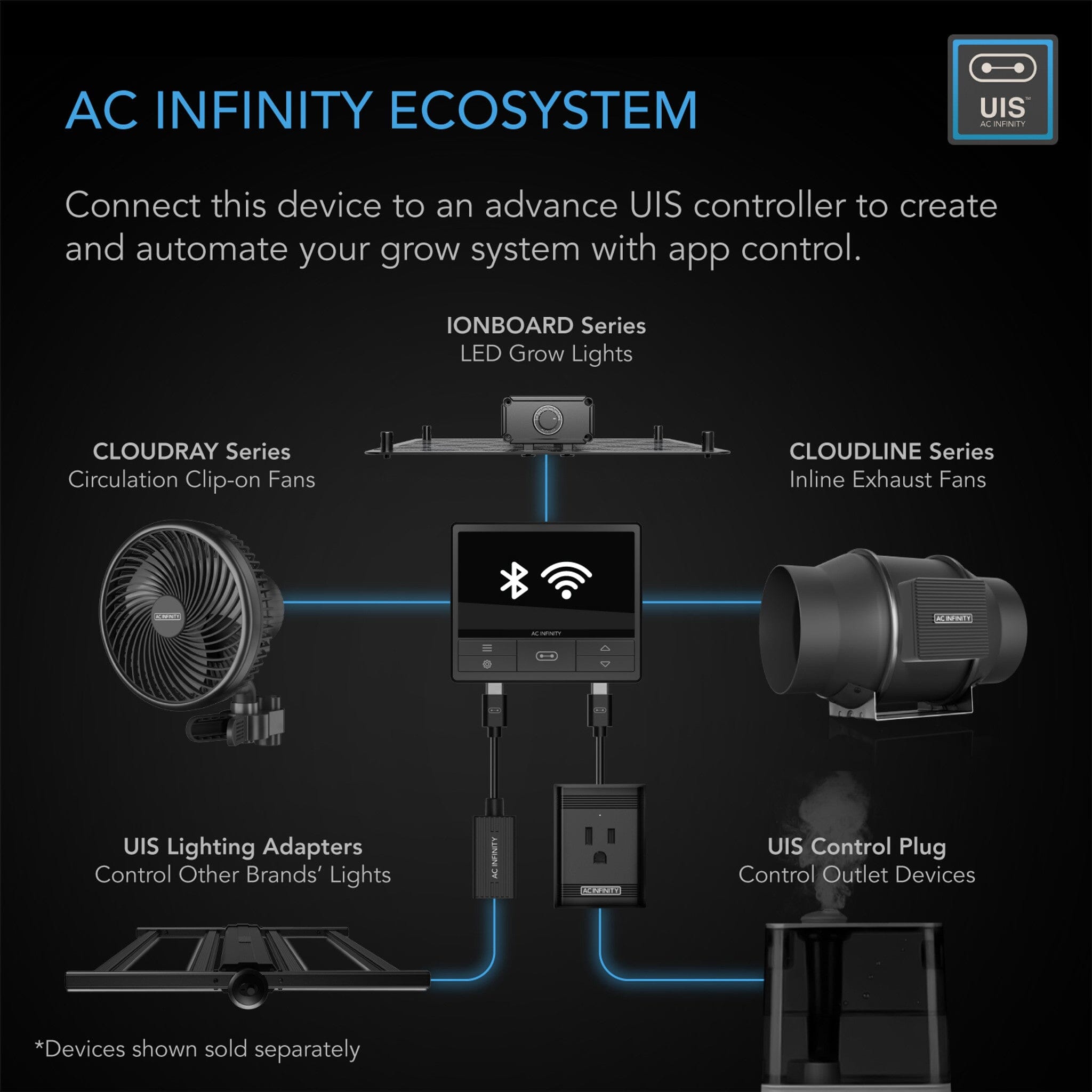
Proportional control matters more on a fan this size than on any other in the range, because the gap between what it draws and what it makes in noise at level 3 versus level 10 is enormous. Connect over WiFi for remote control, push notifications, historical climate charts and CSV export. The controller drives up to four UIS™ devices, so one unit can run this fan plus an intake fan, a Cloudray clip fan, a Cloudforge humidifier or an Ionframe light.
Volume, and the honest trade-offs
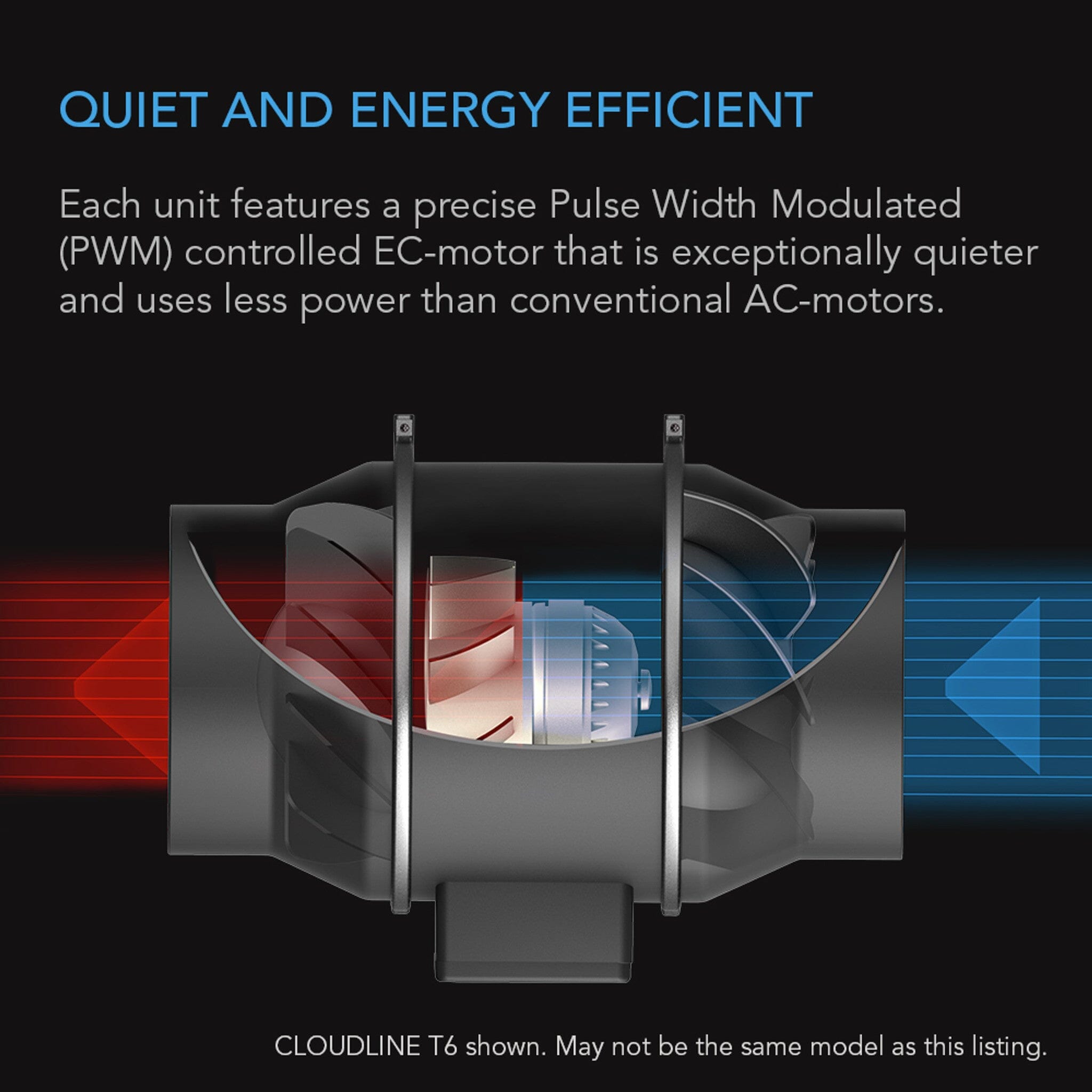
1,604 CFM is the highest free-air figure AC Infinity publish for an inline CLOUDLINE fan, and at 300 mm the T12 moves that air with a large, slow-turning impeller rather than a small one screaming. What it does not do is beat the T10 on pressure: the T12 is rated at 818 Pa against the T10's 1,059 Pa. Under a heavy carbon filter and a long bendy duct run, that difference can hand the win to the smaller fan. The T12 is the right choice when the run is short and relatively unrestricted and you simply need to shift a lot of air.
Power is 139 W average and 250 W maximum — effectively the same as the T10 despite the extra volume, because the larger impeller does the work more efficiently. Draw falls away steeply as you dial the speed back, because fan power scales with roughly the cube of speed. AC Infinity rate the dual ball bearings at 67,000 hours, the fan mounts horizontally or vertically, and the motor box detaches from the frame for impeller cleaning without dismantling the ductwork.
What people use it for
Home ventilation
- Warehouse, plant-room and commercial extraction
- Whole-house and large-footprint subfloor systems
- Large workshops, sheds and machinery spaces
- High-volume ducted exhaust on short, direct runs
- Building-scale air transfer
Hydroponic ventilation
- Large multi-room indoor operations
- Several rooms or tents on one extraction trunk
- High-heat rooms with heavy lighting loads
- Rapid air-change requirements in sealed spaces
- Automated VPD-based environment control
Full specifications
| Manufacturer | AC Infinity Inc. |
| Product / model | CLOUDLINE PRO T12 / AI-CLT12 |
| UPC | 819137021013 |
| Duct diameter | 300 mm (12″) |
| Fan dimensions | 312 × 450 × 357 mm |
| Mounting-hole spacing | 178 × 181 mm |
| Screw-hole diameter | 11.8 mm |
| Cord to controller | 3.05 m |
| Power cord | 2.44 m |
| Controller dimensions | 132 × 74 × 27 mm |
| Controller mounting spacing | 120 × 67 mm |
| Controller screw-hole diameter | 3 mm |
| Display size | 90 × 35 mm |
| Sensor-probe length | 3.66 m |
| Maximum airflow | 2,725 m³/h · 757 L/s (1,604 CFM) |
| Maximum noise | 62 dBA |
| Static pressure | 818 Pa |
| Voltage / frequency | 100–240 V AC / 50–60 Hz |
| Maximum / average power | 250 W / 139 W |
| Current | 2.5 A |
| Power connection | Australian three-pin plug |
| Operating range | 0–60°C / 35–85% RH |
| Ingress protection | IP44 |
| Mounting | Horizontal or vertical |
| Bearings | Dual ball |
| Rated bearing life | 67,000 hours (manufacturer rating) |
| In the box | Fan unit, Controller 69 Pro, corded thermal probe, two duct clamps, mounting hardware, manual |
| Certifications | SAA · CE · ETL · RoHS · IC |
| Product manual | CLOUDLINE S & T series manual (PDF) |
FAQ
Is the T12 overkill for me?
Probably, unless you are ventilating a large grow room or running several spaces off one trunk. For a single 1.5 × 1.5 m (5×5) or 2.4 × 1.2 m (8×4) grow tent, a T8 is the right fan and a T12 would be a waste of money, bulk and noise. Those are grow-tent ratings, not room limits: they allow for a carbon filter, the heat from the lights and roughly one full air change every minute. We'd rather sell you the T8 and have you come back than sell you this and have you fight it. Buy the T12 when volume is genuinely the constraint. For home ventilation, see the airflow and bathroom questions below.
T12 or T10?
Depends on your ductwork, not your room size. The T12 moves more air in free flow: 1,604 CFM against 1,201. The T10 holds pressure better: 1,059 Pa against 818 Pa. Short, straight, lightly filtered run where raw volume is the goal → T12. Long run, multiple bends, a heavy carbon filter and a silencer → the T10 will often deliver more actual air despite the smaller figure on the box. It is one of the few places in this range where the bigger model isn't automatically the stronger one.
Is it quiet?
No — not by the standards of the rest of this range, and it would be dishonest to imply otherwise. It is rated at 62 dBA at maximum speed, against 48 dBA for the T10 and 38 dBA for the T8. Run at the low levels most installations actually use it drops a long way from that figure, and the EC motor keeps the character of the noise low and broad rather than whiny, but this is a commercial-capacity fan. If quiet is a hard requirement, plan for a 300 mm silencer and insulated ducting, mount it away from occupied space, and size it so it never runs near maximum.
What ducting and filters do I need?
300 mm throughout, and it is worth pricing before you commit. Ducting, clamps, carbon filters and silencers at 300 mm are substantially more expensive and bulkier than 250 mm, and the accessory range is narrower again. Reducing a T12 down to 250 mm or 200 mm to reuse existing gear throws away the reason you bought it — it raises static pressure, cuts real airflow and makes the fan louder. If the 300 mm gear isn't in the plan, buy the T10.
How much power does it draw?
139 W average and 250 W maximum — effectively the same as the smaller T10, because the larger impeller moves more air per watt. The maximum figure only applies at full speed.
Can the Controller 69 Pro be powered on its own, separately from the fan?
No. The Controller 69 Pro draws its power through the fan, so it can't run as a standalone unit. This matters if you've since upgraded to a Controller AI+ and want to redeploy the 69 Pro elsewhere — the workaround most customers use is to plug a clip fan (a Cloudray, for example) into the spare 69 Pro. That gives the controller a power source and gets you a second independent climate zone plus a backup controller.
Can I use it for commercial or whole-building ventilation rather than growing?
Yes — warehouses, plant rooms, large workshops and building-scale subfloor systems are exactly where a fan this size makes sense. It's IP44-rated and mounts horizontally or vertically. Read the installation requirements above; at this capacity the ducted system should be designed rather than improvised.
How does the airflow compare with a ceiling or bathroom exhaust fan?
Installers rate exhaust fans in m³/h or L/s. The T12 moves up to 2,725 m³/h (757 L/s) at full speed. For comparison, the National Construction Code minimum for a bathroom or toilet is 25 L/s (90 m³/h), and 40 L/s (144 m³/h) for a kitchen or laundry, discharged outdoors rather than into the roof space. Real airflow drops with every metre of duct, bend and grille, which is where the 818 Pa static pressure rating matters. Check the requirements for your job with your installer.
Do I need a fan this size for a bathroom?
Usually not. Most people use the 150 mm for a bathroom, or the 100 mm for smaller rooms such as ensuites and toilets. The larger the fan, the quieter it is for the same airflow, because it can run slower. The 300 mm is chosen for warehouses, large subfloors, workshops and high-volume duct runs. What suits your job also depends on the space in the ceiling, the duct route and how much noise you can live with, so if you are unsure, send us the details and we will help. Do not install the fan, controller or power connection directly over a shower or bath, or anywhere it can get water spray.
Can one controller run fans in two rooms?
The Controller 69 Pro runs up to four UIS fans, each on its own program, but it has one probe, so temperature and humidity are measured in one place only. A fan in a second room or the far end of a large space would react to readings from somewhere else. For two separate rooms, give each its own fan and controller. Within one room you do not need to switch it off: set a humidity or temperature trigger and the fan ramps up when the steam or heat builds and settles back down after. It also resumes its last setting after a power cut.
Is this a genuine AC Infinity unit with Australian warranty?
Yes. Quick Bloom Lights is the official Australian importer and distributor for AC Infinity. Every unit ships with an Australian three-pin plug, SAA certification, and a two-year warranty handled here in Sydney — no shipping units overseas and no dealing with an offshore seller if something goes wrong.